How to Plan a 90-Second AI Drama Episode: Hook, Beats, Cliffhanger
Short answer: To plan a 90-second AI drama episode, give it a hook in the first few seconds, three or four story beats, one turn, and an ending that makes people want the next episode. Write it as scenes first, then storyboard and make video. In Wandura, Drama Studio takes the script from there.
The test: if you cannot say what changes in the episode in one sentence, the episode is not ready to make.
 Poster for The Wrong Daughter, one of the sample stories in Drama Studio.
Ninety seconds is short. It is long enough for one clear turn in a story and short enough that every second needs a job. That is why planning matters more here than in a long film: there is no room to find the story while you are making it.
This guide gives you a planning method for a short vertical episode. It is a craft method, not a product spec: the timings below are a planning frame you can bend to fit your story. For a standalone short film rather than an episode, see our AI filmmaking guide.
1. Start with the sentence
Before anything else, write one sentence in this form:
At the start, [character] wants [something]. By the end, [what changed], and [the question left open].
Examples of the shape (made up for illustration):
- At the start, a bride wants the wedding to go smoothly. By the end, she has found a message that proves it will not, and she has to decide whether to read it aloud.
- At the start, a new employee wants to impress her boss. By the end, she learns her boss is the person who ruined her family, and she smiles.
If your sentence has two "by the end" parts, you have two episodes.
2. Plan the hook first
The hook is what the audience sees in the first seconds. It does not need to be loud. It needs to be a question.
Strong hooks for vertical drama tend to be one of:
- A line of dialogue that raises a question: "You were never supposed to come back."
- An image that does not add up: a wedding dress on a hospital bed.
- A moment mid-conflict: two people already arguing, no setup.
Avoid hooks that explain. "Meet Anna, a 28-year-old accountant" tells the audience nothing they will care about in two seconds.
3. Use a timing frame (and bend it)
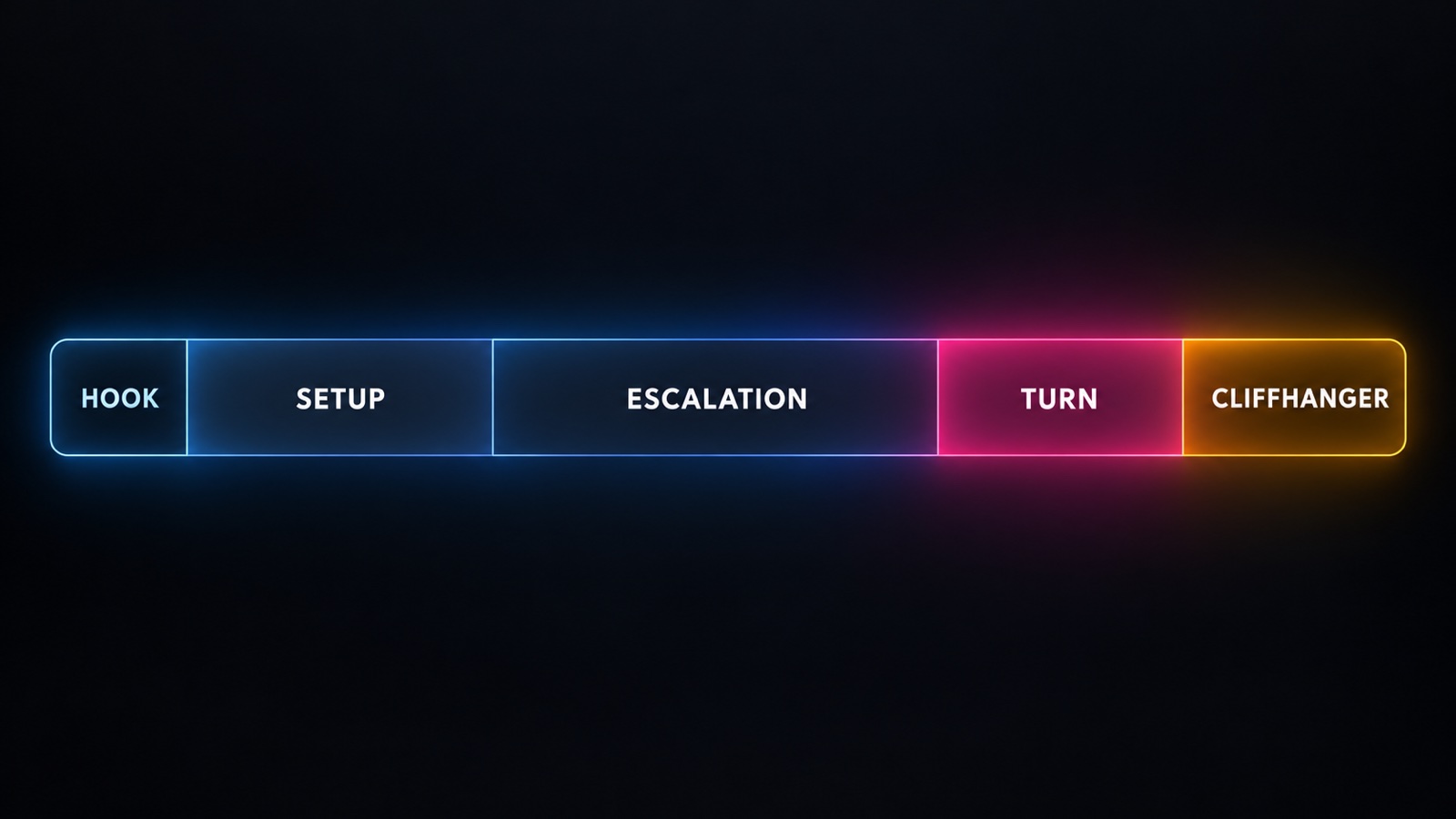 Timeline of a short episode: hook, setup, escalation, turn and cliffhanger.
Here is a frame for 90 seconds. It is a starting point for planning, not a rule:
| Part | Rough share | Job |
|---|---|---|
| Hook | first few seconds | Raise a question |
| Setup | about the first third | Show who wants what, and what is in the way |
| Escalation | about the middle third | Make it worse, with one new piece of information |
| Turn | towards the end | The reveal, threat or choice |
| Cliffhanger | the last few seconds | Stop on the image that begs for the next episode |
If a part does not have a job in your story, shorten it. The turn and the cliffhanger are the parts to protect.
4. Write a beat sheet, not a script yet
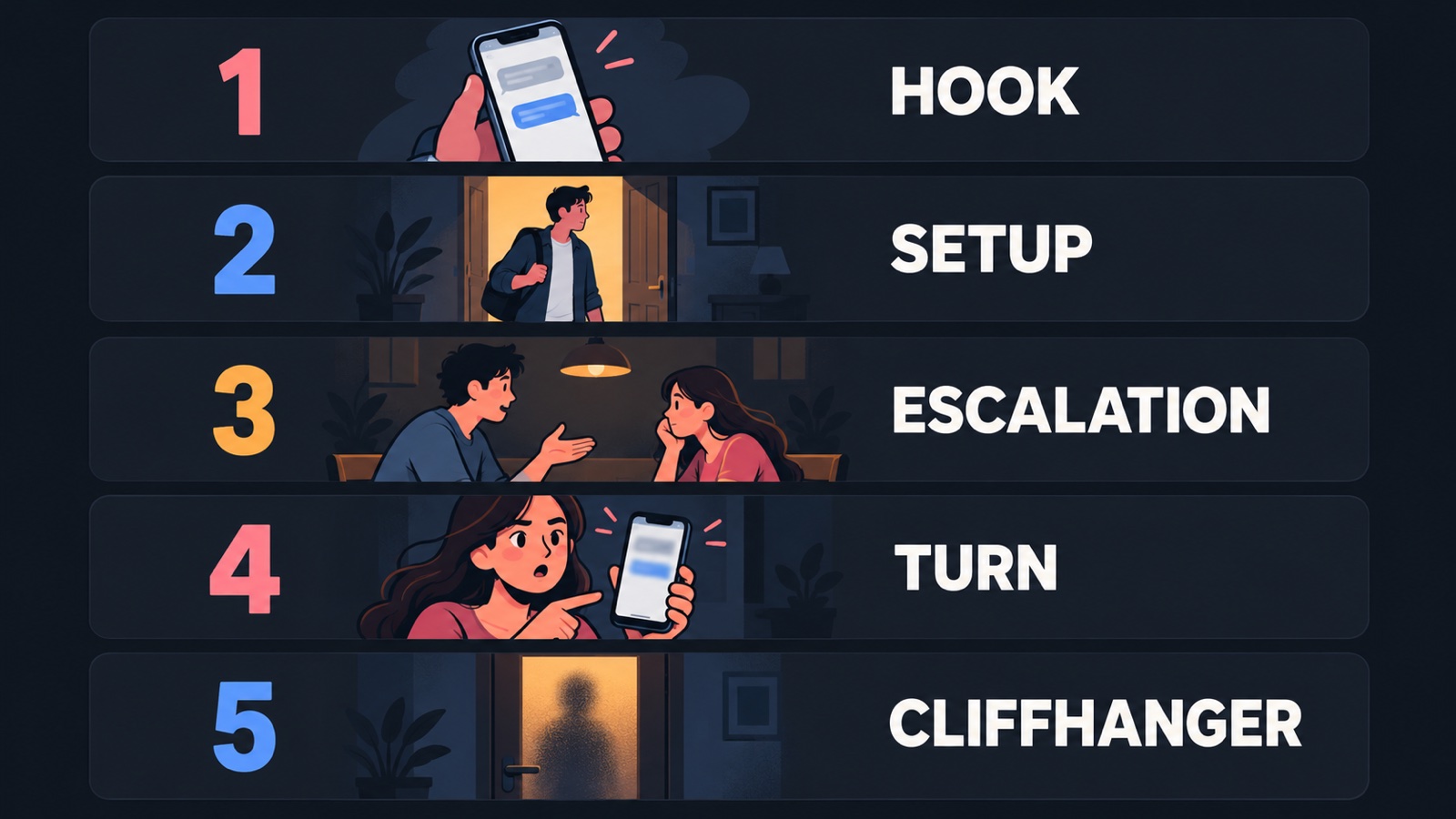 A five-beat sheet for a short drama episode, from hook to cliffhanger.
A beat is one thing that happens. For a 90-second episode, three to five beats is plenty. Write each as one line:
- Hook: she sees the message on his phone.
- Setup: he walks in and acts normal.
- Escalation: she asks one careful question and he lies.
- Turn: she shows him she has already read it.
- Cliffhanger: he looks at the door, where someone is waiting.
If a beat does not move the story forward, cut it. A beat sheet is quick to fix; a finished video is not.
5. Turn beats into scenes
Group the beats into scenes. A scene is one place and one time. For a 90-second episode, one to three scenes is typical. For each scene, write:
- Where and when (one line).
- Who is there (names).
- What changes (the beat).
Keep your cast small. Every extra character is another look to keep consistent across shots and episodes.
6. Write the cliffhanger before you write the middle
A cliffhanger is not a loud ending. It is an unanswered question that the audience cares about. Three reliable types:
- The reveal: someone sees or learns something they should not have.
- The threat: a deadline, a name, a locked door.
- The choice: the character must decide, and the episode ends before they do.
Write it first, then plan backwards so the episode earns it. And decide now what the first image of episode 2 will be, because the last image of this one should lead into it.
7. Pre-flight checklist before you make anything
Run this on the beat sheet:
- Can I say what changes in one sentence?
- Does the hook raise a question in the first seconds?
- Is there one clear turn, not three?
- Does the last image leave something open?
- Are there five or fewer named characters?
- Can each scene be described by one place and one time?
If you answer no to any, fix the plan before you make video.
8. Make the episode
Once the plan is solid, the production steps are shorter than they look.
- Put the script into Drama Studio, by pasting it, writing it in the app or uploading a PDF, DOCX or TXT file.
- Choose Single episode.
- Check the episodes, characters and scenes it found.
- Build your cast so the same faces appear throughout.
- Review the storyboard frames and fix any scene that is wrong.
- Turn each scene into video.
Drama Studio makes 9:16 video by default, and it shows the credit cost before you create. For the details of each step, see our guide to making an AI drama series. For a closer look at the storyboard step, read how to storyboard a script with AI. When the plan is ready, turn the script into video scene by scene.
9. Watch it as a stranger
After you have the episode, watch it once on a phone with the sound on. Pause at the first place your attention drifts. That is where to cut or tighten. Then ask the last question: would I press "next episode"?
How to do this in Wandura
- Open Drama Studio.
- Paste or write your script, upload a PDF, DOCX or TXT, or start from a sample story.
- Choose Single episode and let Drama Studio split the script into scenes and characters.
- Build your cast, review the storyboard and turn each scene into video.
For the full tool page, see AI short drama maker. New accounts get free credits, and the first result carries a wandura.ai watermark.
Frequently Asked Questions
How do I plan a 90-second AI drama episode?
Write one sentence about what changes, plan a hook for the first seconds, outline three to five beats, add one turn and a cliffhanger, then group the beats into one to three scenes. Make the video only after the plan passes a quick checklist.
What makes a good hook for a short drama episode?
A question. A line of dialogue that raises one, an image that does not add up, or a moment already in the middle of conflict works better than an introduction.
How many scenes does a 90-second episode need?
One to three scenes is typical. Each scene should be one place and one time, with one change in it.
What is a cliffhanger in a short drama?
An unanswered question the audience cares about, such as a reveal, a threat or a choice left open. It is usually the last image of the episode.
What should the last image of an episode do?
Leave a question open and lead into the first image of the next episode. A reveal, a threat or a choice left undecided all work, as long as the audience wants the answer.
Keep reading

How to Keep a Character Consistent in AI Video, Shot by Shot

How to Make a 30-Second AI Horror Film: Silence, Knock, Choice
Start creating with 70+ AI models
One account, one credit balance, every model. Pay only for what you generate.
See pricing